available in pdf below
Policy Brief: Incentives Alignment Intervention in the USA Gambling Sector
Policy Brief as originally delivered at the Harvard Kennedy School of Government. The paper focused on defining the problems of the existing gambling system, outlining the proposed policy, defining strategies to engage relevant stakeholders, and developing a framework for research-informed decision-making.
Author: Andrei Linguraru
Final Paper for DEV 102M: Analytical Frameworks for Smart Policy Design

Problem Definition
Gambling addiction is a significant problem. For every addicted person, 6 others are affected.[1] Gamblers face severe constraints (primarily of psychological nature) that distort the assumption of utility-maximising behaviour implied by neoclassical economic theory. For example:
When you are in front of the slot machine, you are mentally detached, space and time do not exist […] The whole time I was in front of the slot machine I just compulsively pushed the button; I could not go away until the money was gone.[2]

Figure 1. Gambling Addiction Rates by Country[4]
Gamblers who know when to stop are close to what the rational agent would do when gambling.[3] Once utility from betting becomes negative, they stop. If a gambler does not stop until they run out of money, then they are the primary target of the proposed intervention.
Addicted gamblers represent between 2 and 6% of US state population and carry an associated social cost of around $30,000 per year.[4]
Thus, this is a highly consequential issue, but the most negative effects are concentrated into a small pool of individuals. The question then becomes, how can gambling design separate between addicted and non-addicted individuals ex ante?
Problem Diagnosis
It's all about incentives
Gambling addiction is heavily influenced by the incentive structure faced by individuals, industry, and government. The diagnostic tree (Figure 2) suggests some of the channels through which this arises.
Individuals desire agency, both in terms of their engagement in betting (seeing gambling as any other normal good) and in terms of accountability. In fact, the majority of Americans still see gambling addiction as a moral weakness.[5] While addressing stigma might be one way to promote help-seeking behaviour, it will not act at the level of the industry and government, thus leaving competing incentives at play.
The gambling industry wants addicted players to bet larger sums. This is largely mechanical, as a result of how they make their revenues. The losses of 5% of the players amount to 70-80% of their income.[4] While responsible betting is claimed as core principle, through its actions, the sector is more likely to follow a rational addiction model.
The government acts in distortionary ways, either through bans (such as in the case of sports-betting until 2018), restrictions, or taxation. The latter is the most common form of shifting consumer demand towards more “desirable” bundles. However, gambling is an industry where markets arise spontaneously (supply of gambling can be provided at a very low cost), so illegal betting is always an available option. Given this and the fact that the industry has lobbying power, plus that the public opinion is unfavourable towards vulnerable bettors (as mentioned above) make it very difficult for the states to intervene.
Theoretical foundation for policy proposal
In economic terms, gambling addiction is a negative externality. It affects society, but the gambler/ betting firm do not internalise the costs associated with those effects. States have imposed taxation to account for it, but it is always challenging to set the “correct” cost, so that utility of all parties is maximised. Ronald Coase [6] has proposed an alternative to taxing externalities, with applications such as the carbon credits exchange.
According to his theorem, if two parties can bargain with no transaction costs, and the property rights are well assigned to one of the parties, then the two can negotiate a price that is mutually satisfying, thus resolving the externality. So, what if the “right to lose” would be assigned to the bettor? In other words, what happens when gamblers have to right to be compensated for their losses? What would the outcome of that bargain with the betting firms be?
In equilibrium, that would be at the point where firms are making zero profits. To be specific, it is where compensation equals the bet price minus the expected value of the cash-outs. For example, if a lottery gives away $1mil. and 1 million people bought a $5 ticket; each bettor would be entitled to get $4 back.

Figure 2. Diagnostic Tree explaining the Incentive Structure that supports Gambling Addiction
No profit, no game?
Since this seems so positive for the bettors, why would the betting firms ever agree to this? This is also a matter of incentives. Assuming no bettor leaves money on the table, the firms make zero profits in expectation. However, because of fixed costs, these turn into negative profits in the long-run. Being aware of this, no firm would provide any bets. However, this would be an analysis at face value, not taking into account that pricing mechanisms are also endogenous. Even if bets themselves lead to zero profits, the process of betting can still be monetised. Casinos were already engaging in a similar practice, tying entertainment with gambling. As such, an entrance fee could cover fixed costs and allow for profits to arise. In online gambling, a subscription fee is another viable option. Therefore, there are many ways in which a firm will be able to continue operations, even under this new setting.
And why were these mechanisms not already in place? A competitive market would mean that if a firm charges an entrance fee for the same product, but another firm does not, all customers would go to the firm that does not. But when no firm is able to survive otherwise, a new equilibrium is created where all firms charge an entrance fee.
There is also another impact of the policy that is favourable to firms. The number of placed bets will increase. First, due to increased demand (cheaper bets mean more bets placed). Second, the limited liability mechanism suggests that risk averse individuals who would otherwise avoid gambling altogether would now want to engage in gambling. Third, but this needs to be empirically tested, illegal betting should drop. If, for the same bet, a bettor can get their money back in the legal market but not in the black market, they should choose to play in the legal market.

Figure 3. Theory of Change for Gambling Addiction Policy Proposal
Policy Design and Implementation
The policy is a legislative proposal that gives individuals the right discussed above. Since this is a bettors’ right, it can be exercised or not. The player who knows when to stop gambling, for the same sum they would have bet, now has two options. They can either claim their money back or not. Regardless, they are better off now with a relaxed budget constraint.
For addicted gamblers, they would run out of money in both scenarios. However, while previously they experienced negative utility since they gambled past their optimum, now, they get compensated for the negative externality imposed on them. This acts like a limited liability mechanism, but with an important difference. If, on the same night, the person gained 99% of their money back, the psychological constraints mentioned in the introduction would compel them to bet until their pockets are empty. The state of the world would be equivalent in both scenarios. But because cash-outs happen ex-post (say, next day), friction is added, so the gambler is given another opportunity to rethink whether they want to engage in a new betting session. This is not coercive, yet it nudges the addicted players in a more positive direction.
Is nudging enough?
A gentle nudge is probably unlikely to help highly addicted individuals. Thus, the implementation of the policy looks as follows: Bettor places a bet today. They lost the bet, so they are entitled to claim their money back minus the expected value of cash-outs. They take their bet receipt and go to their local town hall (or complete an online form, etc.) to obtain the confirmation that they can reclaim their money from the betting firm. Soon after, they contact the firm, who calculates and returns the money that is owed.
If the process is repeated, the government effectively creates a trace of individual betting behaviour. In cases that appear susceptible to addiction (frequent and/or large bets), they can then send a social worker and provide further support as required. This means that the US states’ social services infrastructure is key to ensure successful implementation of the policy.
In summary, the theory of change is presented in Figure 3.
Monitoring and Evaluation Plan
The monitoring plan of the intervention is as follows:

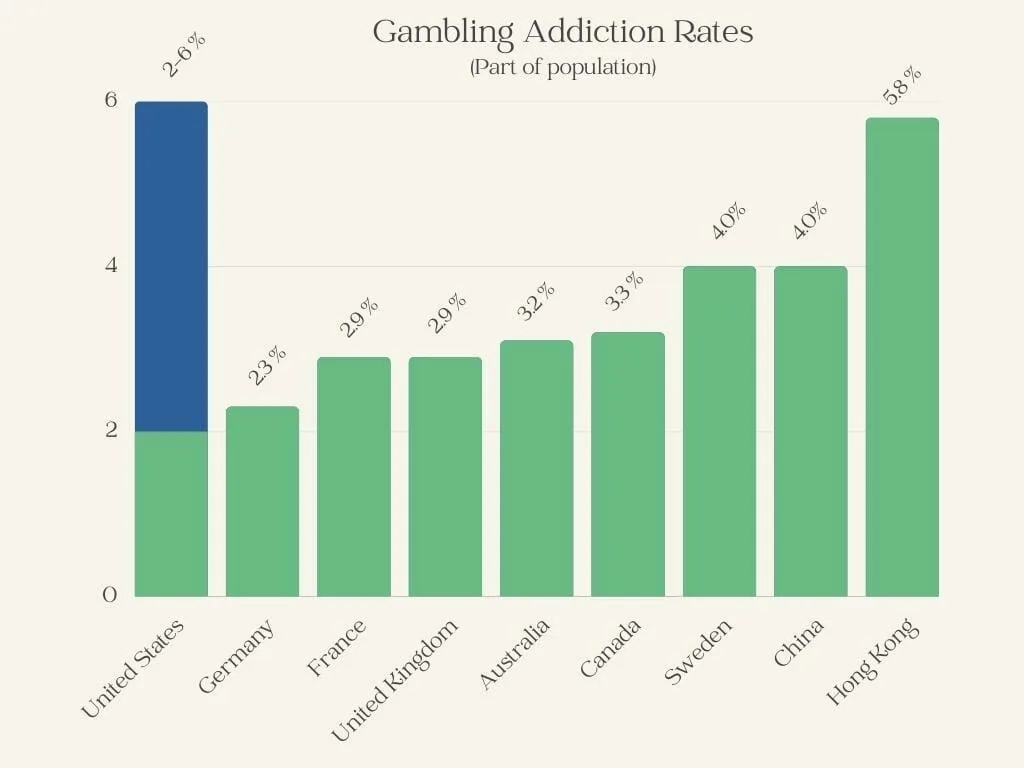
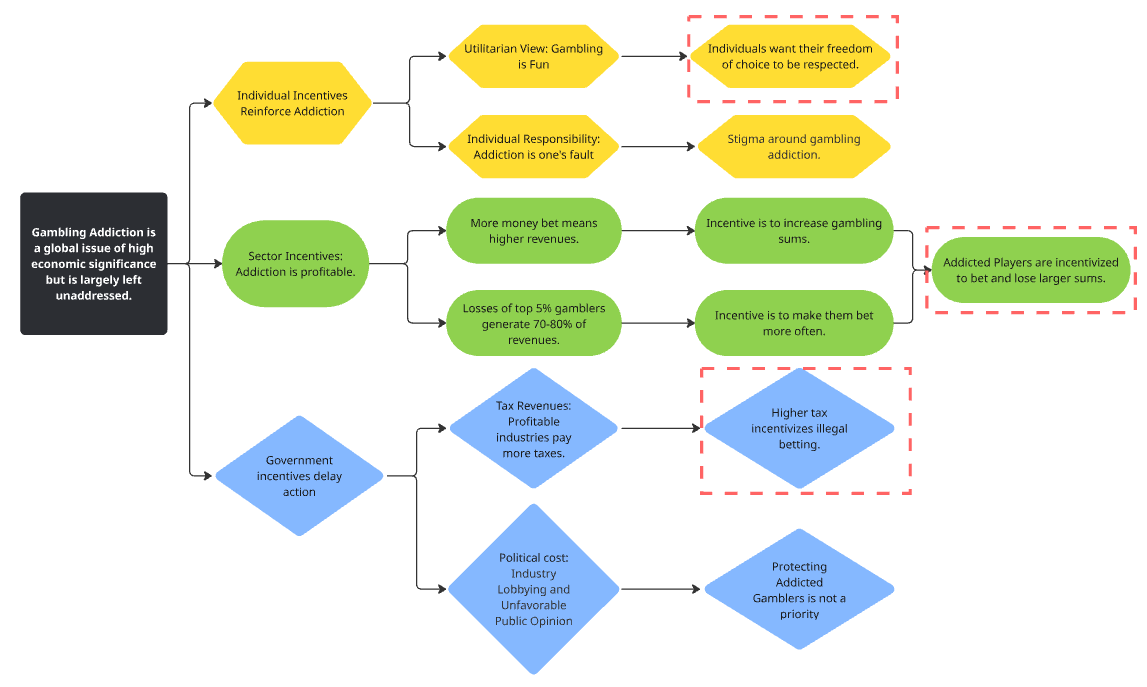
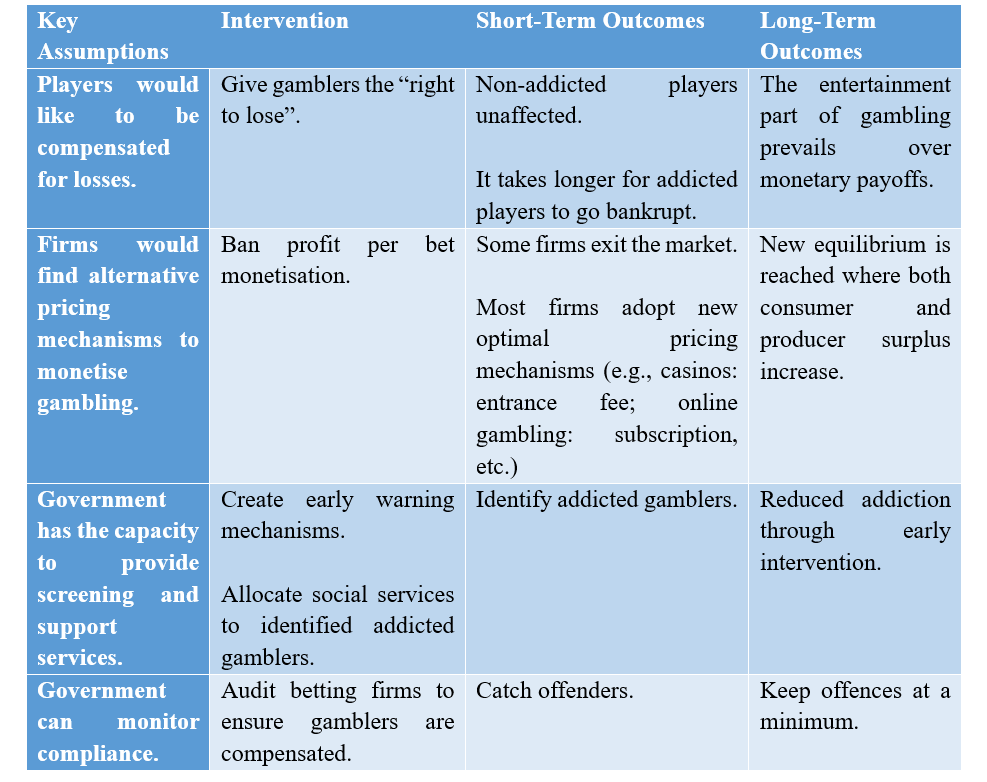
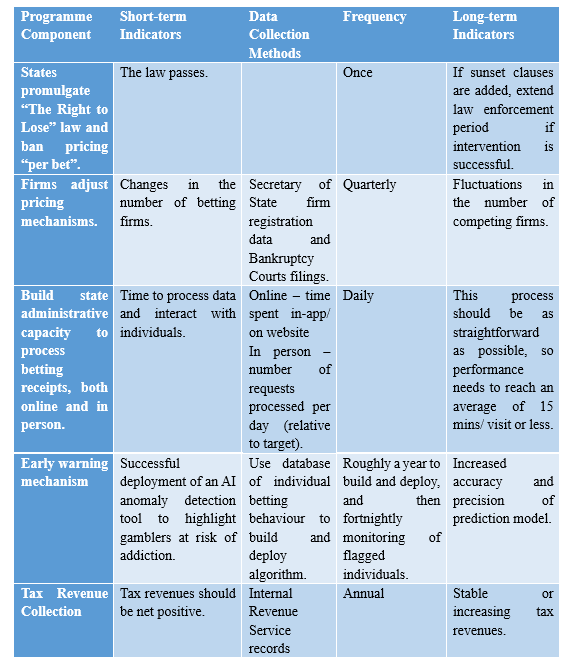
Figure 4. Monitoring and Evaluation Plan
In addition to monitoring implementation, the programme will be evaluated as follows:
Research Design:
-
Event study identifying impact of passing the law, taking advantage of the fact that different states are likely to implement the policy at different times (i.e., phased rollout).
-
Key identification assumption for causality is that the betting industry was not affected by anything else that would have had a significant impact on its performance/behaviour at the same time as the policy intervention. Given how major this overhaul is, it is deemed a plausible assumption.
-
Since gambling addiction is an envelope of problematic behaviours, a host of indicators will be tested using data from national surveys, hospitalisation rates, alcohol consumption, reported domestic violence, web-traffic on illegal gambling websites, and others.
-
Hypothesis 1: The average number of bets per person will increase.
-
-
-
H2: Variance of gambling frequency will decrease (casual bettors gamble more, while the addicted gamble less).
-
-
-
H3: Profits of the gambling industry and tax revenues will increase.
-
-
-
H4: Other harmful behaviours will be substituted with increased engagement in gambling (less alcohol consumed, less domestic abuse, lower debt burden, etc.)
-
-
-
H5: The illegal gambling markets will see decreased traffic (and implicitly profits).
-
Feasibility:
-
Administrative: Capacity building ability may differ across states; thus, one should expect heterogenous effects on the population of interest.
-
Financial: The policy may require additional investment in the social services sector, so that social workers can engage with an increased number of individuals. Moreover, additional support, such as therapy or psychiatric treatment will also have to be budgeted into the healthcare system.
-
Political: With incentives aligned across individuals, the industry, and the government, everyone can benefit in a win-win-win situation.
References
Goodwin, B.C., Browne, M., Rockloff, M., Rose, J., 2017. A typical problem gambler affects six others. International Gambling Studies 17, 276–289. https://doi.org/10.1080/14459795.2017.1331252
Rogier, G., Caputo, A., Langher, V., Lysaker, P.H., Dimaggio, G., Velotti, P., 2020. Giving a Voice to Gambling Addiction: Analysis of Personal Narratives. Cult Med Psychiatry 44, 159–174. https://doi.org/10.1007/s11013-019-09644-7
Becker, G.S., Murphy, K.M., 1988. A Theory of Rational Addiction. Journal of Political Economy 96, 675–700.
207 Gambling Addiction Statistics & Facts 2026, 2026. URL https://quitgamble.com/gambling-addiction-statistics-and-facts/ (accessed 3.21.26).
National Survey on Gambling Attitudes and Gambling Experiences 3.0, 2024. National Council on Problem Gambling. URL https://www.ncpgambling.org/wp-content/uploads/2025/06/NGAGE-3.0-Key-Findings-FINAL-FOR-DISTRIBUTION.pdf (accessed 3.21.26).
Coase, R.H., 2013-11. The Problem of Social Cost. The Journal of Law & Economics 56(4), 837-877. https://www.journals.uchicago.edu/doi/pdfplus/10.1086%2F674872